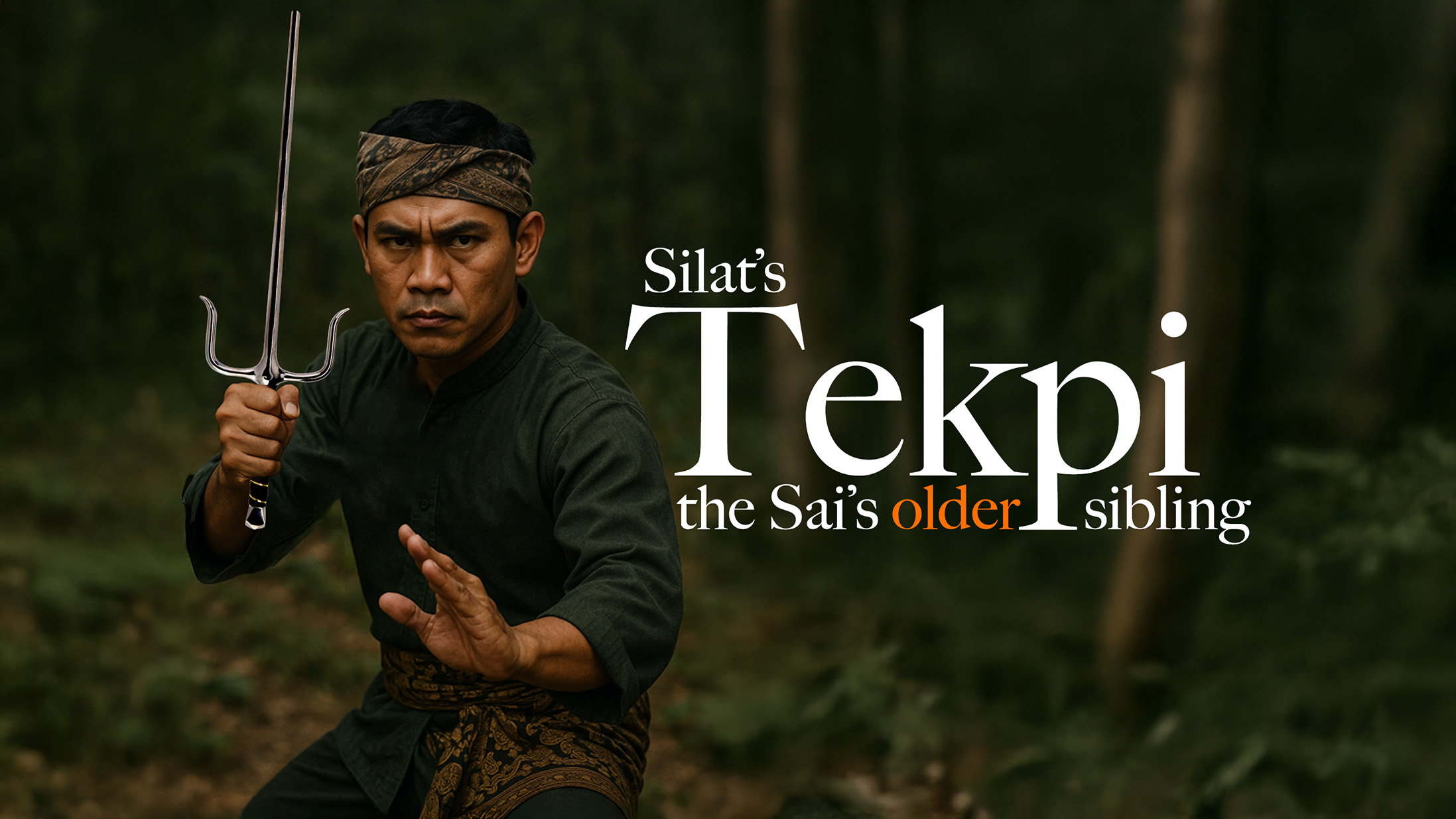
Why the Tekpi’s Ancient Legacy Predates the Pop Culture Sai
If you’ve ever binge-watched Cobra Kai, cheered for Raphael in Teenage Mutant Ninja Turtles, or followed Elektra’s adventures, you’re probably familiar with the sai. This iconic three-pronged metal weapon, often wielded in pairs with dazzling speed, is a staple of Okinawan martial arts and a true star of pop culture. But what if we told you that this beloved weapon has a lesser-known, equally formidable twin from Southeast Asia (the birthplace of Silat) that actually predates its Okinawan counterpart in the historical record?
Get ready to dive into a fascinating journey across continents and centuries, where we uncover the surprising truth about the sai and its mysterious sibling!
The Sai: From Okinawan Streets to Hollywood Screens
The sai, with its distinctive central shaft and two curved side prongs, is synonymous with Okinawan Kobudo and Karate. While often depicted as a ninja’s tool or a martial arts master’s extension of their hand, its history in Okinawa is rooted in practicality. It’s believed to have been adapted for self-defense, possibly by police for crowd control, especially after weapon bans were imposed on the Okinawan people in the 15th and 17th centuries. The Okinawan sai is typically blunt at the tip, designed for striking, blocking, and trapping, rather than cutting. Its “full application” as a self-defense tool became apparent when citizens were prohibited from carrying traditional weapons.
It’s the “Okinawan take on the basic concept,” a unique evolution shaped by the island’s specific needs and martial traditions. But the story doesn’t begin there.
Meet the Tekpi: The Sai’s Older Sibling from Southeast Asia
Across the seas, in the vibrant martial arts traditions of Indonesia and Malaysia, lives a weapon that looks strikingly similar to the sai: the tekpi. Also known as chabang, cabang (meaning “branch”), tjabang, trisula or siang tépi, this three-pronged weapon is a core component of Silat, the traditional martial art of Southeast Asia.
And here’s the kicker: historical evidence suggests the tekpi was around first. The earliest documented evidence of the tekpi comes from the Srivijaya empire in Indonesia, which flourished between the 7th and 13th centuries CE. In Srivijaya, it was originally used defensively, almost like a shield, by palace nobles. Javanese art also depicts the cabang, with sophisticated metalwork from the 13th century providing a timeline for its presence. This means the tekpi was a recognized and specialized weapon in a powerful maritime kingdom centuries before the sai’s documented popularization in Okinawa!
A Shared Ancestry: The Ancient Indian Trisula
So, how did two seemingly identical weapons end up in such distant lands? The answer lies in a common ancestor: the ancient Indian trisula (or trishula). This three-pronged weapon is widely considered the conceptual (and perhaps direct) progenitor for both the sai and the tekpi.
The trisula spread across Asia along ancient trade routes. The Srivijaya empire, a major trade center, played a crucial role in this cultural exchange, facilitating the movement of ideas and objects. This complex, multi-directional diffusion explains why the historical foundations are often “cloudy”.
More Than Just Look-Alikes: Subtle Differences
While they share a common ancestor and a similar silhouette, the sai and tekpi aren’t truly identical. They evolved with distinct characteristics reflecting their unique martial traditions:
- Shape & Sharpness: Japanese sai often have hexagonal or octagonal shafts and are traditionally blunt. Malay tekpi, however, can have “sides” (faceted) and are often sharp at the edge, used for “fast stabs and strikes similar to a knife”.
- Grip & Movement: In Okinawan Karate, the sai is typically held with a “strong and stable hold” for linear strikes and blocks. In Silat, the tekpi is held with a “looser grip” for greater flexibility and agility in fluid, close-quarters combat.
- Purpose: The sai is renowned for blocking, trapping, disarming, and crowd control. The tekpi, while also defensive, is noted for its offensive, piercing capability due to its sharpness, used in conjunction with various strikes and traps.
These differences highlight how a basic weapon concept can be molded by local martial arts philosophies, available materials, and specific societal needs. The “Okinawan take” on the sai is indeed unique, but it stands on the shoulders of a much older, widespread tradition.
So, the next time you see a sai flashing across your screen, remember its ancient lineage and its fascinating twin, the tekpi, a testament to the rich, interconnected history of martial arts across Asia!
